Disclosure: This page contains affiliate links. If you buy through our links, we may earn a commission at no extra cost to you. We only recommend products we have researched and believe are worth your consideration.
A watch winder doesn’t have to live in a drawer. The best ones, whether a €15,000 gyroscopic sculpture or a $60 orbital winder from Amazon, can anchor an entire room’s aesthetic while doing their functional job. This guide covers six distinct display approaches with specific product examples, price ranges, and practical placement advice for each. Whether you’re outfitting a collector’s study or a bedroom nightstand, one of these setups will fit.
1. High-End Statement Pieces: When the Winder Is the Art
The most dramatic display approach treats the watch winder itself as an objet d’art, a sculptural piece that earns its own surface, spotlight, and conversation. A handful of manufacturers have built entire product lines around this concept, producing winders that blur the line between horological tool and fine art object.
The Döttling Gyrowinder (from approximately €14,900) is the benchmark in this category. Its exposed gyroscopic mechanism holds three watches in a rotating sphere of brushed steel and tempered glass, designed to be displayed on a desk or sideboard where the mechanical motion is fully visible. It requires no hiding: the movement is the display. Döttling also produces the Gyrowinder in custom gold and rose gold finishes for bespoke commissions.

Döttling Gyrowinder | from €14,900 | Holds 3 watches | Brushed steel, glass
The Boca do Lobo Cloud Watch Winder (custom pricing; typically $5,000 to $8,000) takes a different sculptural direction: a hand-lacquered cloud form in matte white or gold leaf that houses a single automatic movement. It’s designed to sit on a marble plinth or glass shelf as a centerpiece, with the watch visible through an aperture in the cloud’s face. The piece is produced in limited editions and is as much a collector’s object as the watches it winds.

Boca do Lobo Cloud Watch Winder | Custom pricing | Single watch | Hand-lacquered sculptural form
For a statement piece at a more accessible price point, the Aestoria Orbit Watch Winder (~$150 to $200 on Amazon) delivers a spherical aluminium shell with a rotating outer ring, essentially a miniature armillary sphere that holds one watch. It’s compact enough for a nightstand but distinctive enough to read as intentional décor rather than storage.

Aestoria Orbit Watch Winder | ~$150 to $200 | Single watch | Aluminium
2. Gallery Wall and Floating Shelf Setups
If you own multiple automatic watches, a gallery wall or floating shelf arrangement turns your winder collection into a cohesive display rather than a cluster of appliances. The key design principle: treat each winder as a frame, and the watch inside as the subject.
A practical starting point is two to four compact single or double winders arranged at staggered heights on floating shelves. Mix wood-finish winders with leather-wrapped ones to add material contrast. The Lukdof Single Watch Winder (~$40 to $60 on Amazon) works well in this context: its circular form factor and matte finish don’t compete with the watches on display.
Lukdof Single Watch Winder | ~$40 to $60 | Single watch | Compact for shelf display
Lighting matters significantly in a gallery-style setup. A warm LED strip behind a floating shelf creates a backlight effect that lifts the entire display. LIFX or Govee strips work well at under $30. For watches with open case backs or interesting dials, a small museum-style spotlight (e.g., Puck lights with 2700K output) aimed at the winder face draws the eye without washing out the watch face. Avoid cool-white (5000K+) lighting, which renders leather and wood tones harshly.
For wall-mounted arrangements, consider mixing watch winders with framed movement photographs or technical illustrations. This anchors the display in a horological context without requiring a fully dedicated watch room.
3. Built-In Cabinet and Furniture Displays
A built-in or furniture-integrated display keeps your winders accessible and visible while containing the setup within an existing room’s architecture. This works best in a home office, study, or bedroom with a built-in bookcase, credenza, or media unit.
The approach is straightforward: dedicate one shelf or cabinet compartment entirely to watch winders, lined with a piece of dark felt or velvet to absorb ambient light and create contrast. If the cabinet has glass doors, the display reads as curated storage; if it’s open-fronted, it reads as an active collection. Either works.
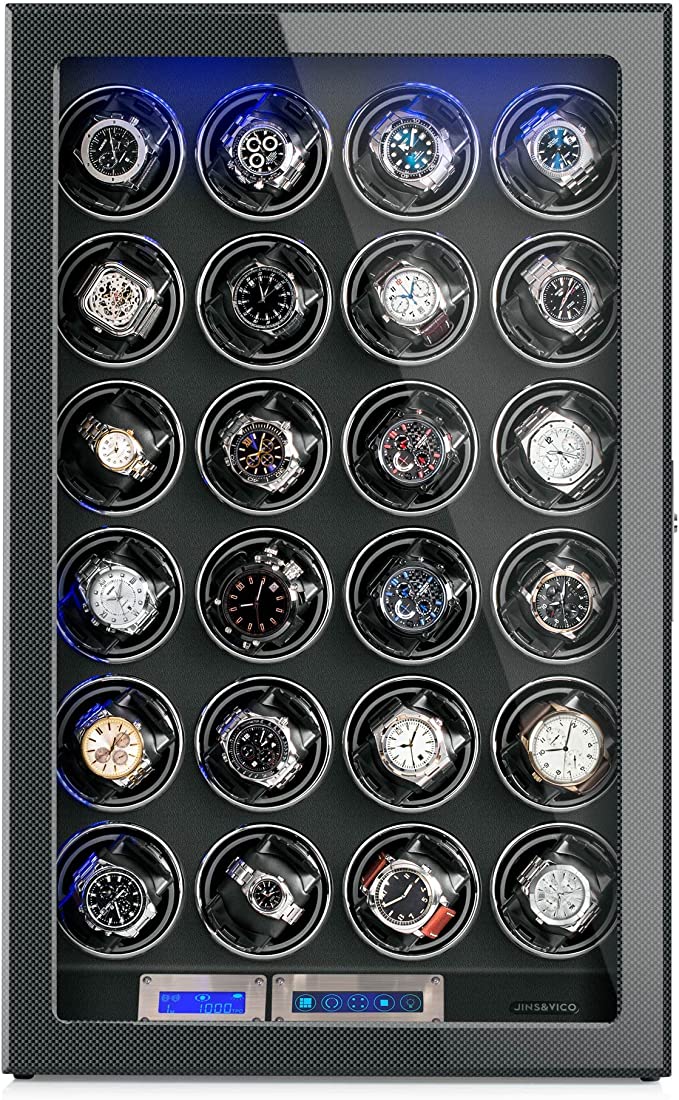
For this context, multi-watch winders from established brands like Wolf (the Heritage Double Winder, ~$400, in carbon fibre or brown leather) or Orbita (the Sparta 4, ~$600 to $800, brushed aluminium) are particularly well-suited. They have the visual weight to hold a shelf and the capacity to wind the watches you reach for most often. Both brands use quiet motors, which matters when the winder lives in a shared room.
Room placement note: a built-in cabinet beside a desk puts the winders at natural eye level when seated, so you can check which watch is wound without standing up. Bedroom installations are most useful on a dresser or wardrobe alcove shelf, where you pass them during your morning routine.
4. Drawer and Discreet Storage Winders
Not every collector wants their watches on display. For those who prefer a discreet setup, or who share a home with children, pets, or guests who shouldn’t be handling expensive watches, a drawer-integrated or low-profile winder keeps things secure without sacrificing functionality.
Drawer winders are designed to sit flat in a drawer compartment, often with a velvet lining built into the unit itself. The one shown below fits within a standard deep dresser drawer and requires only a pass-through power cable to operate. Price range on similar units: $30 to $120 depending on motor quality and number of watch positions.

Drawer-integrated watch winder | flat profile, velvet-lined, requires only a cable pass-through
If discretion is the goal but you still want the winder visible on a surface, consider compact barrel-style single winders with a leather exterior. These read as a leather box rather than a mechanical device and blend naturally on a nightstand or vanity. The Barrington Single Watch Winder (~$100 to $130) in tan or black leather is a frequently recommended option in this category: quiet motor, programmable turn direction and turns-per-day (TPD), and a form factor that doesn’t announce itself as a winder to the uninitiated.
5. Novelty and Themed Designs
If your collection aesthetic leans toward the unconventional, there’s a growing niche of watch winders designed to make you smile as much as wind your watch. These aren’t gimmicks. The best novelty winders use the same quality motors and TPD programming as their conventional counterparts. The form is just considerably more interesting.
Steampunk and industrial designs are the most developed sub-category here. Look for winders with exposed brass gears, copper pipe fittings, and rivet detailing. These pair particularly well with vintage or tool watches (Submariner, Speedmaster, PAM). Prices range from $80 to $400 depending on build quality; most are produced by smaller independent makers and sold via Etsy or Alibaba-adjacent retailers.
Astronomical and planetary designs, winders styled as orreries or armillary spheres, work well for collectors of complicated watches (perpetual calendars, tourbillons, astronomical complications). The Aestoria Orbit shown in Section 1 falls into this category at the accessible end. At the premium end, custom orrery-style winders can be commissioned for $500 to $2,000.
Figurative novelty winders (animal or robot shapes) are most commonly found in the $30 to $100 range from Chinese manufacturers on Amazon. Quality is variable. Check that the motor is programmable (CW, CCW, both) and that the TPD range covers your specific movement’s requirements before purchasing on aesthetics alone. For reference, most ETA movements need 650 to 950 TPD, while Rolex in-house movements typically need 800+ TPD.
6. Budget-Friendly Creative Displays Under $75
Creative display doesn’t require a premium budget. The most effective budget approach separates the winder from the display: buy a functional single winder ($30 to $50) and invest in the surface, lighting, and context around it.
A $15 oak display riser or a $20 acrylic plinth elevates a basic cylindrical winder to something that reads as deliberate. Add a small LED puck light (pack of 6 for ~$12 on Amazon, warm white 2700K) mounted to the underside of a shelf above, and the winder acquires a museum-object quality for under $30 in accessories. The total investment for a polished single-watch display using this approach: roughly $65 to $90.
Alternatively, a small dedicated tray, a leather catchall, a wooden jewelry tray, or even a repurposed cigar box, creates a defined zone for a winder and a few watch straps, which signals intentionality without requiring dedicated furniture. The tray communicates “this is a collection” rather than “this is a device sitting on a shelf.”
For multi-watch collectors on a budget, the Mcbazel Double Watch Winder (~$50 to $70 on Amazon) holds two automatic watches with individually programmable motors and a faux-leather exterior that reads better than its price suggests. It’s not a statement piece, but on a properly lit shelf with a tray below it and a framed photograph beside it, it becomes part of a cohesive display.
Choosing the Right Display for Your Collection
The right display approach depends on three factors: how many watches you rotate regularly, how visible you want them, and what the surrounding space already looks like. Statement pieces (Sections 1 and 5) work best as focal points in dedicated spaces. Gallery and cabinet setups (Sections 2 and 3) work best in multi-use rooms where the display needs to coexist with other furniture. Drawer and discreet setups (Section 4) work best where security or minimalism takes priority. Budget setups (Section 6) work anywhere with the right accessories.
Whatever approach you choose, the display logic is the same: context elevates the object. A $60 watch winder on an oak riser under a warm light, beside a framed technical illustration, reads as a considered collector’s display. The same winder on an empty shelf with a tangle of cables looks like storage. The difference is $30 in accessories and five minutes of arrangement.
Our Curated Picks for Every Display Style
The products below were selected to represent a cross-section of the display approaches covered in this guide, one high-end statement piece, one mid-range multi-watch winder, and one compact budget-friendly option for shelf and tray displays.
| Product | Best For | Capacity | Price Range |
|---|---|---|---|
| Aestoria Orbit Watch Winder | Statement piece / orbital aesthetic | 1 watch | ~$150 to $200 |
| Lukdof Single Watch Winder | Gallery shelf / compact display | 1 watch | ~$40 to $60 |
| Mcbazel Double Watch Winder | Budget multi-watch / shelf display | 2 watches | ~$50 to $70 |
Prices are approximate and subject to change. Check current pricing via the links above.