Disclosure: This page contains affiliate links. If you buy through them, I earn a small commission at no extra cost to you. This review reflects independent research, verified buyer feedback, and competitive analysis, not paid placement.
You’ve got an automatic watch. Maybe a Rolex Sub, an Omega Seamaster, or a Tudor Black Bay. You’re tired of resetting the time every Monday morning. A watch winder seems like the obvious fix, but the cheap ones on Amazon sound like broken kitchen timers, and the good ones from Wolf or Orbita cost $200 to $300 for a single slot.
That’s where the Barrington Single Watch Winder enters the picture. At around $90, it sits in genuinely interesting middle ground. Not bargain-bin, not boutique-priced. After going through its specs and a lot of owner reviews, I think it earns its reputation. This review covers what you’re getting, where it falls short, and who should buy it.
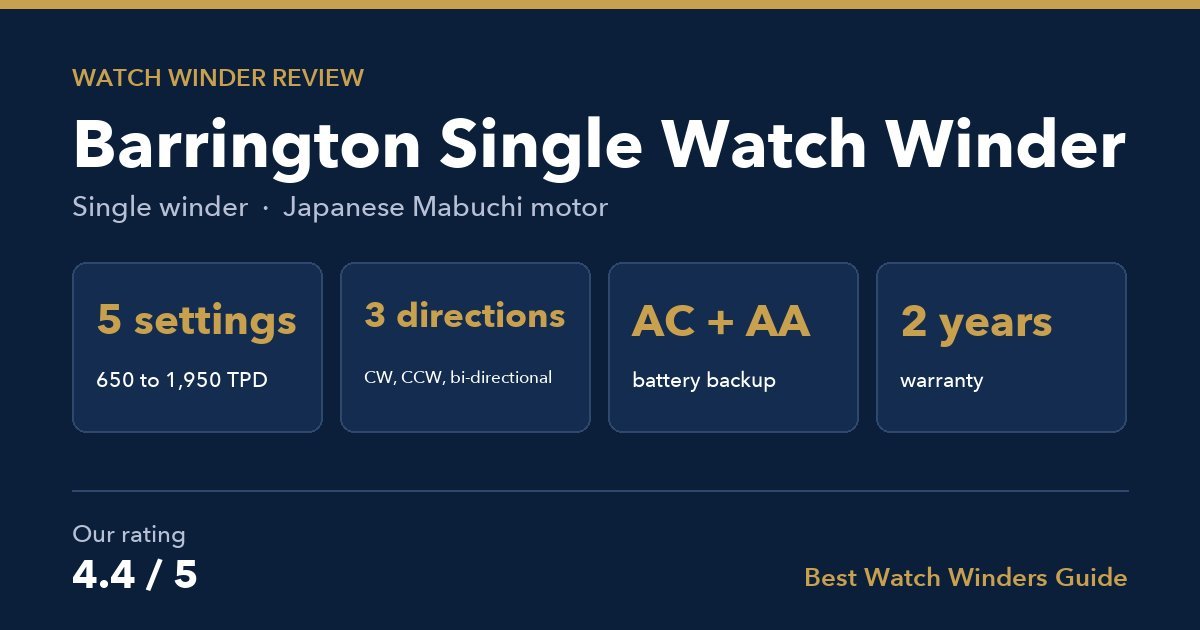
Bottom line: The Barrington delivers quiet operation, a clean piano-lacquer finish, and real TPD customization at a price that undercuts comparable winders by $60 to $150. For most single-watch owners, it’s the right call.
Barrington Single Watch Winder: Quick Overview
Barrington is a UK-based brand that’s been making watch winders since 2009. Their pitch is simple: look as good as the premium names, perform just as well, cost considerably less. They’ve built a real following among enthusiasts who want something serious without spending collector-grade money on the box their watch sits in.
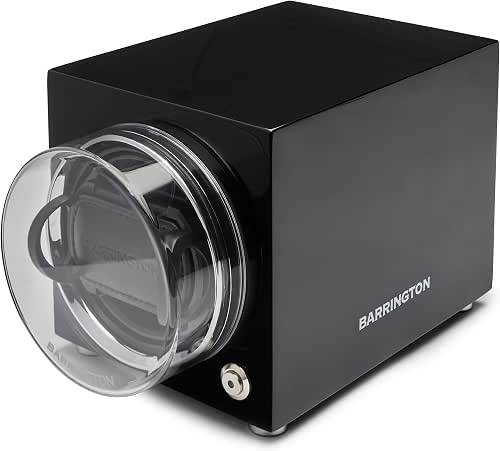
The single winder comes in multiple colorways (Shadow Black, Glacier White, and others), all with a piano-lacquered wooden housing. It runs on AC power or AA batteries, and multiple units can be daisy-chained through Barrington’s Jump system.
Quick Specs
| Specification | Details |
|---|---|
| Dimensions | 11.5cm W × 12cm H × 16cm D (approx. 4.5″ × 4.7″ × 6.3″) |
| Motor | Japanese Mabuchi (silent) |
| Rotation Directions | Clockwise, Counter-clockwise, Bi-directional |
| TPD Settings | 650 / 750 / 850 / 1,000 / 1,950 |
| Winding Cycle | 12 hours on / 12 hours off |
| Band Width Compatibility | 16mm to 26mm |
| Power | AC adapter + 2× AA battery backup (60 to 70 days) |
| Multi-unit Capability | Yes, via the Barrington Jump daisy-chain system |
| Warranty | 2 years |
| Price | ~$89.99 |
| Amazon Rating | 4.4/5 (1,000+ reviews) |
Check current price on Amazon →
Build Quality and Finish
The Barrington is built as a wooden box, not the hollow plastic shell you find on sub-$40 winders, and that accounts for much of the price difference.
The piano-lacquer finish is the standout visual detail. It’s the same high-gloss treatment you’d expect on a quality speaker cabinet or piano lid: deeply reflective with clean edges. The Barrington logo appears on both sides near the base, kept small. It’s the kind of detail that says “we thought about this” rather than “we slapped a logo on it.”
Around back, the adjustment controls sit on a steel plate with printed labels. Most winders at this price point use bare plastic dials with no backing.
I haven’t had one in my hands, so these build notes come from Barrington’s specifications and product photos. For how it holds up over months of use, the owner reviews are the better guide.
Key Features and Performance
1. Japanese Mabuchi Motor: Built for Quiet Running
Motor noise makes or breaks a watch winder, and this is where the Barrington earns its price. It runs on a Japanese Mabuchi motor rather than the cheap DC motors found in most budget winders.
By owners’ accounts, it’s quiet enough to live on a nightstand or in a home office without becoming an annoyance. Reviewers consistently cite the quiet motor as the feature that won them over after coming from cheaper winders with DC motors that sound like struggling ceiling fans.
The motor runs what Barrington calls “Gentle Rotation”: 10 rotations over roughly 90 seconds, then a pause. This cycle repeats over 12 hours, followed by a 12-hour rest. It mimics natural wrist movement more accurately than continuous-spin winders and eliminates the risk of overwinding.
2. TPD Settings: Five Options, Almost Any Movement
Five turns-per-day options (650, 750, 850, 1,000, and 1,950) cover the vast majority of automatic movements. Rolex movements typically need 650 to 800 TPD. Omega calibers often call for 650 to 1,000. More demanding movements or those with high power reserves may need up to 1,950.
You set TPD via a dial on the back panel alongside the rotation direction. No app, no Bluetooth, no pairing. For most owners, keeping a single watch wound, that simplicity is exactly right.
One thing to know about bi-directional: When set to alternating, the Barrington splits the TPD count. Half clockwise, half counter-clockwise. It does not double the total rotations. If your movement manual specifies TPD in one direction only, account for that when selecting your setting.
3. 12-Hour Cycle: Smarter Than Always-On
The 12-hour on, 12-hour off cycle is one of Barrington’s best design decisions. Many budget winders run continuously, which strains the mainspring and wears out the winding mechanism faster. The Barrington more closely replicates how a watch gets wound during daily wear.
Practically, it means you’ll want to plan the timing. If you start it in the morning, it rests in the evening. Start it at night, it runs while you sleep. Neither creates a problem. Most movements have 40-plus hours of power reserve. But it’s worth knowing the rhythm before you set it up.
4. Cushion System: Fits Most Watches
The velcro cushion system fits band widths from 16mm to 26mm, covering nearly every watch you’d consider winding: slim dress pieces to large sport watches, including 44mm-plus cases.
Barrington offers standard and flex cushion options. The flex cushion uses a carbon-fiber-pattern thread that looks sharp against the winder’s clean exterior and compresses more easily around larger cases. Installation takes about ten seconds and holds firm from the first try.
5. Power Options and the Jump System
AC power is the primary method, and the adapter is included. The battery backup (2× AA) gives 60 to 70 days of operation, useful for placement away from outlets or travel use.
The Jump system is where the Barrington earns loyalty among collectors running more than one automatic. A short connecting cable lets you chain multiple winders together and power all of them from a single AC adapter. Two, three, four winders: one outlet. Combined with the stackable design, a row of Barrington single winders looks intentional rather than cobbled together.
Real-World Performance
The Barrington performs reliably with Rolex Submariner, Omega Seamaster, Tudor Black Bay, Seiko 5 Sport, and Grand Seiko dress watches. All maintained accurate time and full power reserve across extended winding periods.
The main complaint from real owners: the LED indicator. A small light in the top-left corner blinks during the active winding cycle. In a dark bedroom, it’s noticeable. The fix is timing the active period to run during daylight hours, but it’s worth knowing if nightstand placement is the plan.
On long-term reliability: most owners report trouble-free operation for two to four years. There are occasional reports of motor failure around 18 months. It doesn’t appear to be a systematic problem, but it does happen, and it’s worth knowing before you buy. Barrington’s 2-year warranty covers it.
The controls on the back panel mean adjusting TPD or direction requires moving the winder. For a set-it-and-forget-it setup, this is a non-issue. For anyone frequently rotating different watches with different movement requirements, it’s a mild friction point.
Pros and Cons
Pros
- Genuinely quiet motor. Unobtrusive in any room.
- Piano-lacquer finish that looks more expensive than it is.
- Five TPD settings (650 to 1,950) covering virtually all popular movements.
- 12-hour cycle protects against overwinding and simulates real wear.
- AC plus battery power for flexible placement.
- Jump system: one adapter powers multiple units.
- 2-year warranty, better than most at this price.
- Wide cushion range (16 to 26mm band widths).
Cons
- Blinking LED can be distracting in dark bedrooms.
- Back-panel controls require moving the unit to adjust.
- No continuous rotation. A small number of movements require it.
- Occasional early motor failures reported around 18 months. Covered by warranty, but worth knowing.
Who Should Buy the Barrington Single Watch Winder
Best For:
- First-time winder buyers who want a real step up from cheap Amazon units without paying Wolf or Orbita prices.
- Rolex, Omega, and Tudor owners whose movements fit cleanly within the TPD range and who want a winder that looks good next to a serious collection.
- Collectors expanding to multiple winders. The Jump system and consistent aesthetic make Barrington easy to scale.
- Home office or display shelf setups where the clean design earns its place as a display piece, not just a functional box.
Skip It If:
- You’re a light sleeper planning nightstand placement and can’t work around the LED timing.
- Your movement requires continuous rotation (some specialized calibers do).
- You want app control or programmable scheduling. The Barrington is fully analog, by design.
Also Consider
Single Winder Alternatives
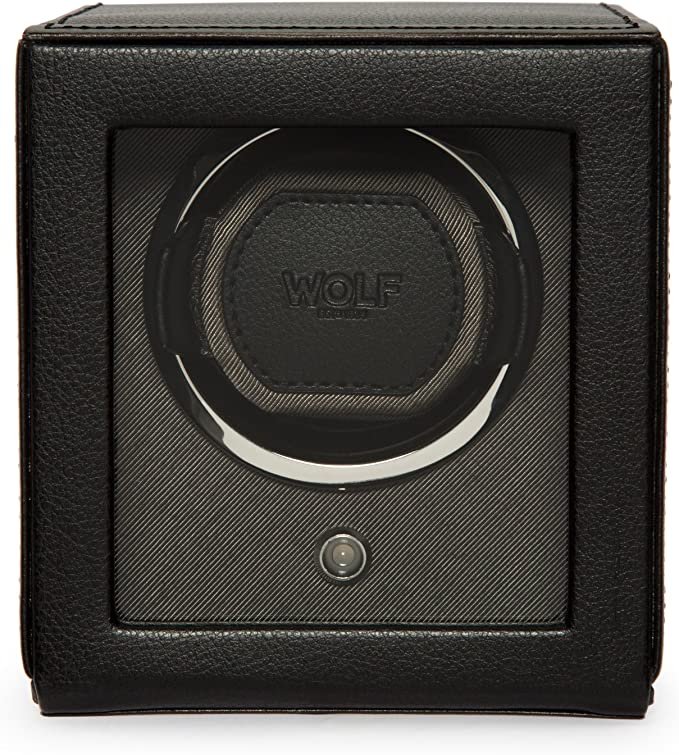
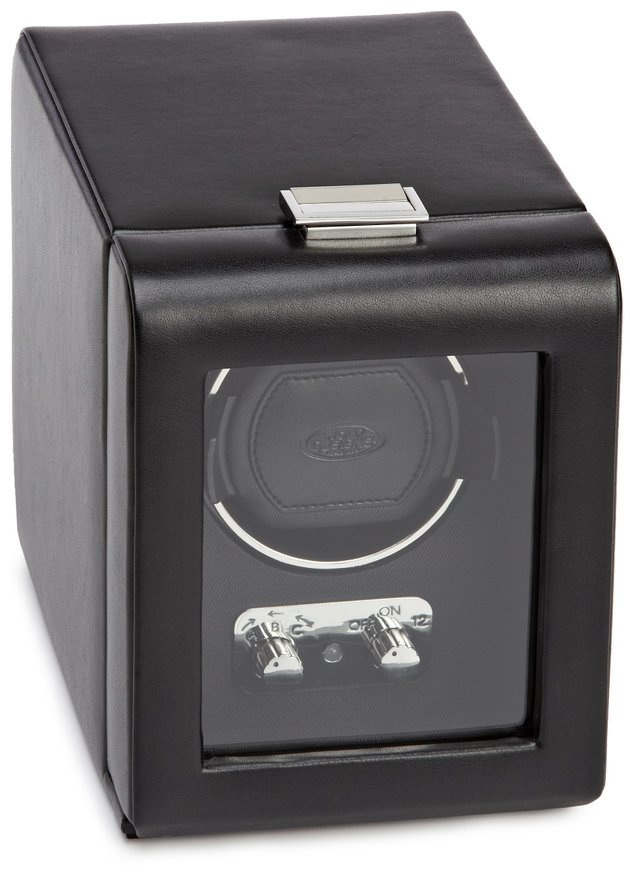
Budget down, step up to Wolf’s entry-level, or go premium.

As an Amazon Associate I earn from qualifying purchases.
Barrington Single Watch Winder: Frequently Asked Questions
What watches is the Barrington Single Watch Winder compatible with?
It works with all automatic (self-winding) watches and fits band widths from 16mm to 26mm. That covers the vast majority of watches: slim dress pieces through large sport watches.
How quiet is the Barrington Single Watch Winder?
Very quiet. The Japanese Mabuchi motor produces no perceptible hum or whirr during normal operation. You’ll hear nothing from across the room. The only noise-adjacent issue is the blinking LED indicator, which is a visual rather than an audio problem.
Does the Barrington work for Rolex watches?
Yes. Rolex movements (Submariner, Datejust, Day-Date, GMT-Master II calibers) typically require 650 to 800 TPD and bi-directional winding. The Barrington’s 650 and 750 TPD settings and bi-directional mode match these requirements well. It’s one of the most common use cases for this winder.
What is the Barrington Jump system?
The Jump system lets you connect multiple Barrington winders with a short cable so they all draw power from a single AC adapter. Second winder plugs into the first, third into the second. Practical for anyone running several winders side by side who wants to keep outlet use to a minimum.
Can I use the Barrington on battery power?
Yes. Two AA batteries provide approximately 60 to 70 days of operation. Useful for placement away from power outlets, travel, or as a backup during power interruptions.
How do I set the TPD and rotation direction?
Both settings are controlled via dials on the back panel. TPD options: 650, 750, 850, 1,000, and 1,950. Rotation direction: clockwise, counter-clockwise, or alternating. No digital interface. The back panel includes a printed reference guide for selecting settings.
Is the Barrington Single Watch Winder worth the price?
At around $90, yes. You’re getting a silent motor, quality construction, five TPD settings, and a 2-year warranty at a price point that’s $60 to $150 below comparable winders from Wolf or Orbita. The gap between Barrington and the premium brands exists, but it’s smaller than the price difference suggests.
What is the Barrington warranty?
Two years. Customer service is generally reported as responsive and helpful for warranty claims. That warranty coverage is notably better than most competitors at this price point.
Final Verdict: Barrington Single Watch Winder Review
The Barrington earns its price. The piano-lacquer finish looks expensive, the Mabuchi motor is legitimately quiet, and five TPD settings handle every common automatic movement you’re likely to own. The 12-hour cycle protects your watch. The Jump system scales with a growing collection. The 2-year warranty is a genuine backup.
The LED is a real thing. The back-panel controls are a mild annoyance if you swap watches frequently. A small number of units have had early motor issues. None of these are deal-breakers at $90.
If you’re choosing between a $30 plastic spinner and a $200-plus Wolf, the Barrington is the right answer for most people. Not a compromise. The genuinely smart call.
Rating: 4.4 / 5
Check the Barrington Single Watch Winder on Amazon →