Disclosure: This page contains affiliate links. If you buy through them, I earn a small commission at no extra cost to you. This review is based on analysis of verified buyer feedback, manufacturer specifications, and competitive comparison research. Not paid placement.
Eight independent winding positions, diamagnetic motors that actively protect your watches from magnetization, and an LCD touchscreen on every slot. The JINS & VICO 8 Watch Winder puts specific numbers on things most 8-slot winders in this tier don’t. Most of them check out, though the headline noise figure does not. Five TPD presets (650, 750, 850, 1,000, and 1,950 turns per day) with per-position independent control cover every mainstream automatic movement. The carbon fiber piano finish and blue LED illumination make it a display unit, not a utility box. The tradeoffs are real too: AC power only, no programmable delay start, and timer-based winding rather than optical turn-counting. Here’s what matters and what doesn’t.

This review is based on owner reports from WatchUSeek and Amazon, manufacturer specifications, and competitive comparison against other 8-slot winders in the same price tier.
Check Price and Availability on Amazon →
Quick Specs
| Specification | Details |
|---|---|
| Model | JINS & VICO 8 Watch Winder, Piano Finish |
| Capacity | 8 independent winding positions |
| TPD Settings | 650 / 750 / 850 / 1,000 / 1,950 turns per day (per position) |
| Rotation Modes | Clockwise, Counter-Clockwise, CW+CCW (per position, independently set) |
| Motor | Japanese motor with diamagnetic materials (anti-magnetization) |
| Noise Level | 5dB claimed by the manufacturer; not physically credible (see below). Owner reports describe it as inaudible at bedroom distance |
| Display | LCD touchscreen per position |
| Lighting | Blue LED illumination (switchable on/off) |
| Door Function | Optional motor shutoff when door is opened |
| Watch Pillows | 8 adjustable flexible pillows; spare S and L size pillows included |
| Exterior | High gloss carbon fiber piano finish |
| Dimensions | 16.1″ x 11.1″ x 7.9″ |
| Weight | 17.7 lbs |
| Power | AC adapter (included), no battery option |
| Amazon ASIN | B07Z3MR4XH |
What Makes the JINS & VICO 8 Different
Most budget 8-slot winders skip diamagnetic motor protection. JINS & VICO doesn’t. Standard watch winder motors generate an electromagnetic field. In cheap units, that field reaches the watch movement and magnetizes the hairspring or escapement lever, causing accuracy loss that requires a watchmaker visit to correct. JINS & VICO engineers diamagnetic materials into the motor assembly specifically to contain the field. This is meaningful protection for watches already at risk from everyday magnetic exposure (smartphones, tablet covers, bag clasps) and a feature you won’t find at every price point.
Noise is where we part company with the marketing. JINS & VICO publishes a 5dB figure, and most manufacturers in this tier publish nothing at all, so the instinct is to credit them for it. Do not. The threshold of human hearing sits at 0dB, and a professional anechoic chamber bottoms out around 10dB. A device with eight motors in it does not produce 5dB at any distance you would measure from. The number is marketing, not measurement, and we would rather say so than repeat it.
What survives the scrutiny is the owner testimony, which is consistent and worth more than the spec sheet. Across WatchUSeek threads and Amazon reviews, the recurring description is inaudible at bedroom distance, with several owners specifically reporting they sleep in the same room. Treat this as a genuinely quiet winder that a manufacturer oversold, rather than a quiet winder with a verified number behind it.
Independent per-position control is the core practical argument for this tier over budget alternatives with shared controls. If you’re winding a Rolex (650 TPD, clockwise) in position 1 and an Omega Seamaster (650 to 800 TPD, bi-directional) in position 2 and a Breitling Navitimer (800 to 900 TPD, bi-directional) in position 3, each can be configured independently. A shared-control 8-slot winder forces you to pick one setting and apply it to everything, which over-winds some watches and under-winds others. Use the table below as a starting reference; always verify against your manufacturer’s documentation.
| Brand / Movement | Recommended TPD | Direction | JINS & VICO Setting |
|---|---|---|---|
| Rolex (all calibers) | 650 to 800 | Clockwise | 650 TPD, CW |
| Omega (Co-Axial, Master Co-Axial) | 650 to 800 | Bi-directional | 650 TPD, CW+CCW |
| Patek Philippe | 650 to 800 | Bi-directional | 650 TPD, CW+CCW |
| TAG Heuer | 600 to 800 | Bi-directional | 750 TPD, CW+CCW |
| Breitling | 700 to 900 | Bi-directional | 850 TPD, CW+CCW |
| IWC | 650 to 900 | Bi-directional | 750 TPD, CW+CCW |
| Tudor | 650 to 800 | Bi-directional | 650 TPD, CW+CCW |
| Audemars Piguet (Royal Oak) | 650 to 800 | Bi-directional | 650 TPD, CW+CCW |
| Panerai | 650 to 800 | Bi-directional | 650 TPD, CW+CCW |
| Seiko / Grand Seiko | 500 to 650 | Bi-directional | 650 TPD, CW+CCW |
Pros and Cons
What’s Great
Genuinely quiet in owner reports. The manufacturer’s 5dB claim does not hold up to scrutiny, but the consistent owner feedback behind it does: inaudible at arm’s length, with multiple reviewers reporting bedroom use without complaint. Bedroom placement is practical.
Diamagnetic motor protection. The motor assembly uses diamagnetic materials to contain the electromagnetic field generated during operation. This actively prevents the winder from magnetizing watch movements, a real failure mode of cheap motors that can affect timekeeping accuracy and requires a watchmaker to correct.
8 truly independent positions. Each slot has its own direction and TPD controls, programmable via the LCD touch screen. For a collector with 8 watches across different brands and winding requirements, this is the minimum you need. Shared-control winders force one setting for all, a compromise that serves no watch optimally.
Five TPD presets covering the full range. The 650/750/850/1,000/1,950 presets hit all meaningful targets: 650 for Rolex and Omega, 750 to 850 for Breitling and IWC, 1,000 for high-demand specialty movements. The 1,950 setting is rarely needed for mainstream brands but covers edge cases without requiring a custom winder. Most buyers will use 650 or 750 and leave it there.
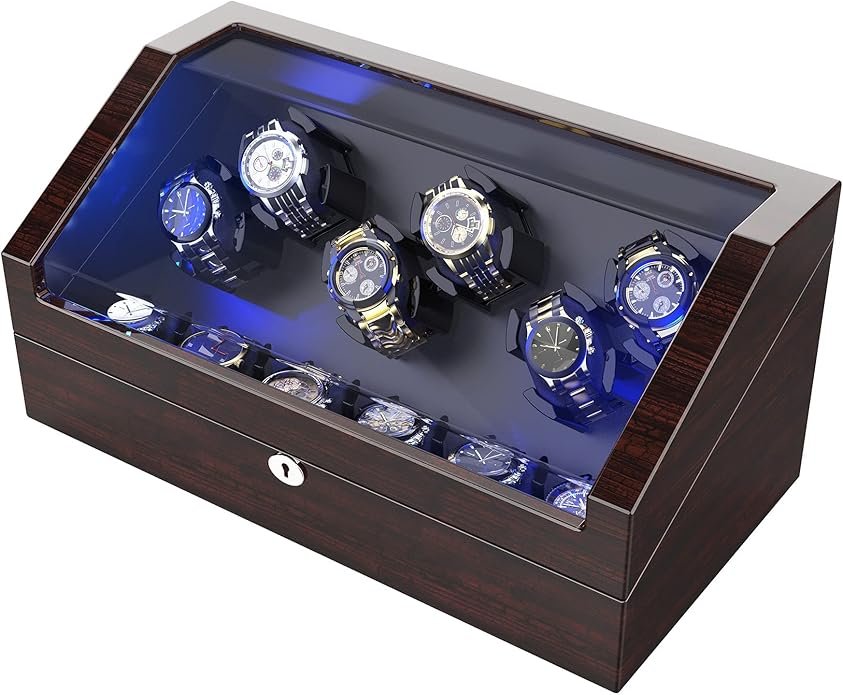
Premium display aesthetics. The high-gloss carbon fiber piano finish, blue LED illumination, and LCD touch screen make this a display piece you leave visible. The LED is switchable on/off, which matters for bedroom placement. The door-shutoff feature pauses the motors when you open the panel, preventing contact with spinning drums.
Limitations
AC power only, no battery option. The unit runs on the included AC adapter with no battery backup. Placement is constrained to within cable distance of an outlet, and the unit stops winding during power outages. Collectors who want placement flexibility or travel use should look at winders with dual AC/battery power.
No programmable delay start. There is no option to delay the start of a winding cycle. It begins immediately when powered. For collectors with perpetual calendars or annual calendars, a delay start matters: the mainspring should fully deplete before winding begins to allow the complication to complete its own cycle. Wolf’s Roadster Double offers up to 72 hours of programmable delay; this unit does not.
Timer-based winding, not optical turn-counting. The winder runs the motor for a set time and estimates the resulting turn count, the same approach used by most winders in this price tier. Wolf’s patented system uses an optical counter to track actual turns and stop at the exact TPD programmed. For the vast majority of collectors, timer-based winding at the correct TPD preset is sufficient. If you have a perpetual calendar or a movement with very precise TPD requirements, Wolf’s system offers a meaningful accuracy advantage.
The 1,950 TPD setting is worth explaining. At first glance, 1,950 TPD looks like a feature. More range is better, right? In practice, no mainstream automatic watch from Rolex, Omega, Breitling, IWC, or Patek Philippe needs 1,950 TPD. The slipping clutch in automatic movements prevents overwinding regardless, so high TPD isn’t dangerous, but it’s also unnecessary and runs the motor more than required. If you set it to 1,950 without knowing why, you’re just running the motor longer than needed. Stick to 650 to 850 for virtually all watches.
What Long-Term Owners Are Saying
Noise and build quality get consistent praise across Amazon and WatchUSeek. The marketing number does not hold up, but the underlying experience does. The most common observation is that the unit is effectively silent at arm’s length, with multiple reviews specifically noting bedroom use without issues. The carbon fiber piano finish consistently rates better than expected at the price point. Photos on the listing undersell the actual build quality. The LCD touch screen interface draws praise for clarity; setup is described as intuitive, usually completed without needing the manual. The main complaint thread on WatchUSeek involves the watch pillows: the standard pillows fit most sports watches comfortably, but collectors with very large cases (47mm+, heavy Panerai, large AP Royal Oak Offshore) report needing the oversized pillows supplied in the kit or aftermarket solutions. A minority of reviews flag the AC-only limitation, typically from buyers who expected battery capability. Read current customer reviews on Amazon →
Alternatives to Consider
ARCTICSCORPION 12 Watch Winder: 6 active winding positions plus 6 passive storage slots. German motors with near-identical noise performance to JINS & VICO; four rotation modes including a 3-hour sleep cycle. The right choice if you need passive storage alongside winding, or if you’re rotating a larger collection. Higher price but significantly more total capacity. Check price →
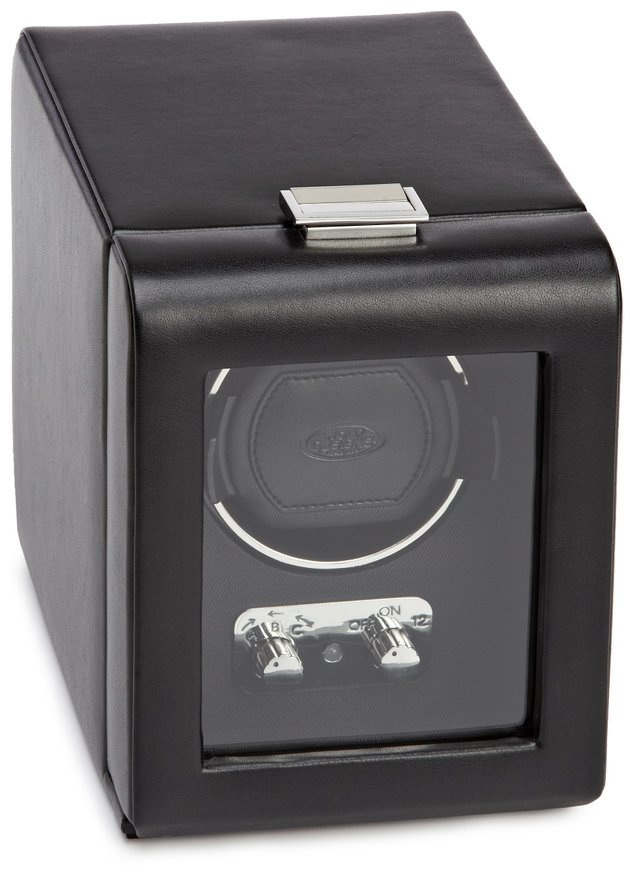
WOLF Roadster 6-Piece Watch Winder: Wolf’s 6-slot unit uses patented optical turn-counting rather than timer estimation, and Wolf publishes a warranty and backs it with direct customer service. A step up in per-position winding accuracy; a step down in total capacity vs. the JINS & VICO 8. Right for collectors who prioritize precision over slot count. Read our review →
Jqueen 8 Watch Winder: the most direct budget competitor at this capacity. Quieter on price, comparable slot count, but motors are noisier in owner reports and there is no diamagnetic protection claim. The right choice if budget is the primary constraint and magnetization risk is not a concern. Check price →
Also Consider
8-Slot Winder Alternatives
More capacity, tighter budget, or premium precision. These cover the spectrum.

As an Amazon Associate I earn from qualifying purchases.
TPD and Direction Settings by Watch Brand
Eight independent positions are only useful if you set each one correctly. These are the settings collectors and winder makers converge on for the brands most likely to end up in a winder of this size. Set direction to bidirectional (CW+CCW) for everything below, which is what every modern automatic here expects. Where a brand publishes nothing official, that is noted, because most of them do not.
| Brand | TPD | Notes |
|---|---|---|
| Rolex | 650 | Perpetual rotors wind both ways. No official Rolex figure exists |
| Tudor | 650 | In-house MT calibers behave like Rolex |
| Omega | 650-750 | Co-Axial calibers wind efficiently at the lower end |
| Breitling | 650-850 | In-house B01 prefers 800 |
| Grand Seiko | 850 | 9S calibers want more turns. Spring Drive takes the same |
| Seiko automatic | 650-850 | Older 7S movements wind one way and prefer the higher setting |
| Casio G-Shock | n/a | Quartz or solar, so no winding at all. A winder does nothing for it |
The 1,950 TPD preset has no mainstream application. No major brand asks for anything close to it. Our full guide to selecting the ideal TPD setting covers the reasoning and the less common calibers.
Frequently Asked Questions
Can each of the 8 positions be controlled independently?
Yes. Every position has its own directional setting (CW, CCW, or CW+CCW) and TPD setting (650/750/850/1,000/1,950), configured via the LCD touch screen independently of all other positions. You can run 8 different watches at 8 different settings simultaneously. Budget winders apply one shared setting to every slot. That’s the practical difference.
What TPD setting should I use for a Rolex?
650 TPD, bidirectional (CW+CCW). Rolex Perpetual rotors wind in both directions, so there is no need to restrict the winder to clockwise, and 650 TPD sits at the low end of the 650 to 800 range winder makers recommend for Rolex calibers, sufficient to keep the mainspring wound without unnecessary motor run time. Do not use 1,950 TPD on a Rolex; it is not harmful (the slipping clutch prevents overwinding) but it is unnecessary and wears the motor faster.
Does it protect against magnetization?
Yes. JINS & VICO uses diamagnetic materials in the motor assembly to contain the electromagnetic field. Diamagnetism is the property that makes a material repel a magnetic field rather than concentrate it. Standard motors in budget winders generate a field that can magnetize the hairspring or lever, causing accuracy loss that requires a watchmaker to correct. The diamagnetic motor addresses this risk directly. It’s one of the few features in this price range that has real technical merit behind it.
Does it run on batteries?
No. AC adapter only, no battery backup. If you need placement away from an outlet, battery capability, or continued operation during power outages, this is a genuine limitation. The Wolf Heritage Single and Wolf Roadster Double both offer dual AC/battery power as an alternative, though at lower capacity.
What does the door shutoff feature do?
When enabled, opening the front panel automatically pauses all winding motors. This prevents a spinning drum from contacting your hand or watch case when you reach in to retrieve or place a watch. It’s a practical safety function. Worth enabling. When disabled, the motors continue running while the door is open.
Is 1,950 TPD safe for my watch?
Mechanically safe, yes. Automatic movements have a slipping clutch that disengages when the mainspring is fully wound, so overwinding through a winder is physically impossible. But 1,950 TPD is far higher than any mainstream brand recommends, and running at that level simply means the motor is running longer than necessary. For Rolex, Omega, Breitling, TAG Heuer, IWC, Panerai, or any other mainstream automatic, use 650, 750, or 850 TPD.
Are watch winders good or bad for your watch?
Good, when set correctly. A winder keeps the mainspring wound and the lubricants distributed, which is why it matters most for perpetual calendars and annual calendars that are tedious to reset. The failure mode is not the winder itself, it is running one at a far higher TPD than the movement needs, which adds motor hours and wear for no benefit. Set it to what the caliber asks for and the argument against winders largely evaporates.
Is it bad to leave my automatic watches on a winder all the time?
No. Winders are designed for continuous operation and most, including this one, cycle in bursts with rest periods rather than turning nonstop. Leaving watches on a correctly set winder indefinitely is normal use. What does matter is the environment: keep the winder cool, dry and out of direct sunlight, and follow ordinary watch winder maintenance so dust does not reach the mechanism.
Does Rolex recommend watch winders?
Rolex does not endorse or publish settings for third-party winders, and it does not sell one. That silence is often misread as disapproval. It is not: Rolex service centres wind and run watches as a matter of course, and nothing in a correctly set winder conflicts with how a Perpetual movement is designed to work. The practical consequence is that every TPD figure you will see quoted for Rolex, including ours, comes from winder manufacturers and collectors rather than from Rolex.
Which brand of watch winder is the best?
There is no single answer, because the honest split is by budget tier. WOLF is the reference at the premium end, where units are built to be serviced and parts remain available for years; our WOLF Heritage review covers what that buys you. In the mid range, JINS & VICO and Jqueen dominate the multi-slot category on price per position, and we cover the latter in our Jqueen double winder review. Below roughly $50, expect a fixed program and no per-position control. Motor quality and the availability of replacement parts predict lifespan better than brand name alone.
Verdict
The JINS & VICO 8 belongs in the mid-range 8-slot category. The 5dB noise spec is marketing rather than measurement, though the unit is quiet in practice, and the diamagnetic motor protection is a technically meaningful feature that most competitors in this tier don’t offer, and the per-position independent control handles a diverse collection correctly. The AC-only power and absence of a programmable delay start are real limitations. If those matter to you, budget up to Wolf or down to a dual-power competitor with fewer slots. For a collector with 6 to 8 active automatics, a stable outlet location, and no perpetual calendars in the mix, the JINS & VICO 8 is a well-built, properly quiet winder at a fair price. Check current pricing on Amazon →