Best Watch Winders Guide
Watch Winder Buying Guide
Everything you need to know before buying a watch winder — from how they work to which one is right for your collection. Independent, reader-supported reviews.
As an Amazon Associate I earn from qualifying purchases.
TPD Settings Explained
Understand turns per day and how to set yours correctly.
Rotation Direction
CW, CCW, and bi-directional — what your watch needs.
Quiet Motors
Why motor noise matters and what to listen for before buying.
Right Capacity
Single to large-capacity: size your winder to your collection.
What Makes a Good Watch Winder?
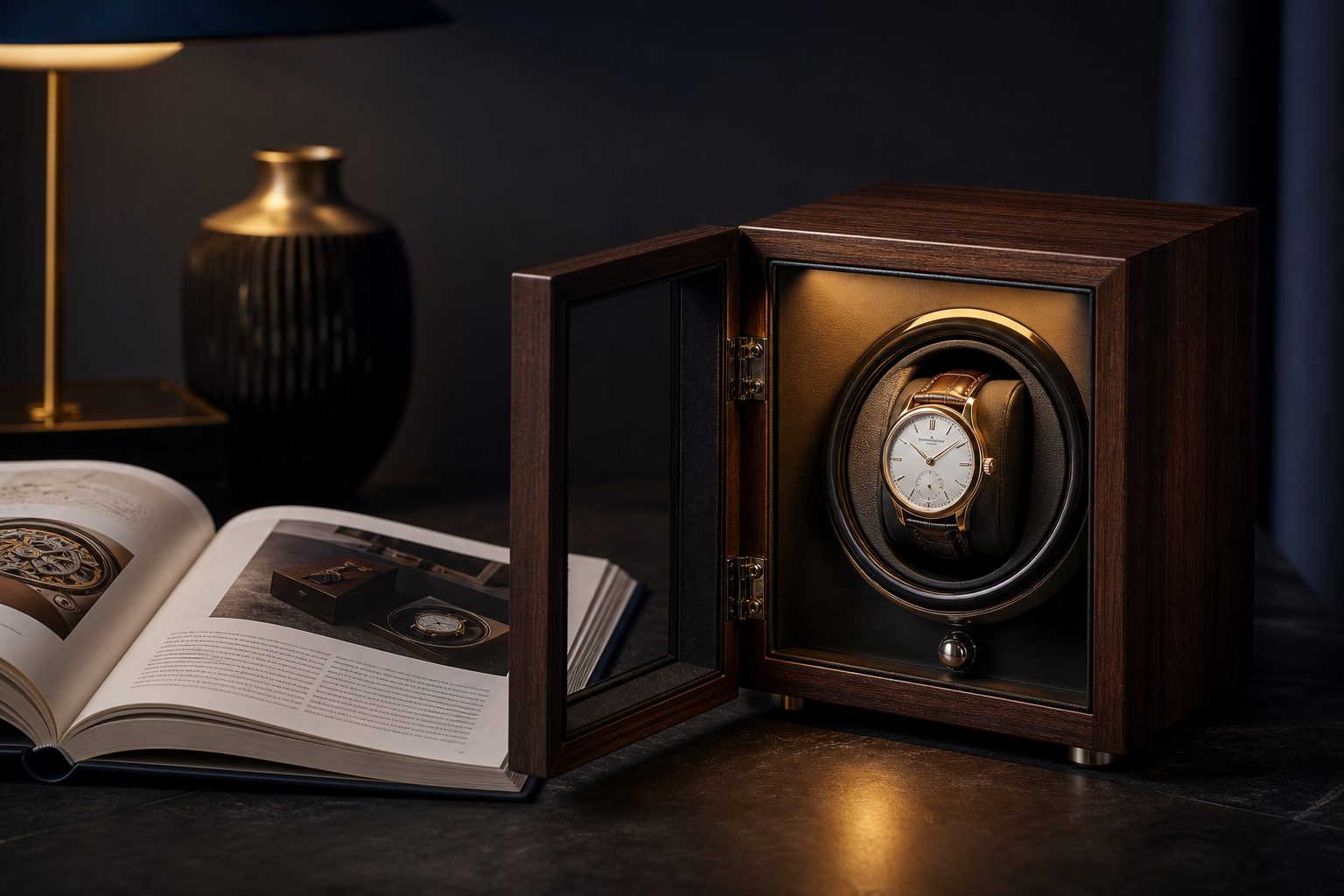
A good watch winder rotates your automatic watch at the correct turns per day (TPD) in the right direction, using a quiet motor that won’t disturb the movement. It should be built from quality materials, fit your collection size, and run reliably without manual intervention. The best ones offer programmable settings, AC power with a battery backup option, and a soft-lined interior that protects the watch case and bracelet.
Before You Buy
Do You Actually Need a Watch Winder?
If you wear your automatic watch every single day, you don’t need one — your wrist movement keeps it wound naturally. But if you rotate between multiple watches, you do.
An unworn automatic watch will stop within 24–72 hours, requiring you to reset the time, date, and any other complications every time you wear it. That’s inconvenient for a simple date display — and genuinely painful for a perpetual calendar or moon phase.
Find the Right Winder →You probably need one if:
- You own more than one automatic watch
- You don’t wear the same watch every day
- Your watch has date, day, or moon phase complications
- You dislike resetting time and date manually
- You want your watches ready to wear at all times
- You want to display your collection while keeping it wound
You don’t need one if you wear the same automatic watch every day without exception.
The Mechanics
How a Watch Winder Works
Your Watch Sits in a Rotating Cradle
The winder holds your watch in a padded, fabric-lined holder that rotates on a motorized axis. The cradle is designed to accommodate different case sizes and bracelet types.
The Motor Rotates at Programmed Intervals
The motor turns the cradle at a set number of rotations per day (TPD) in a direction you configure — clockwise, counter-clockwise, or alternating bi-directional. The rotor inside your watch swings with the movement, transferring energy to the mainspring.
Your Watch Stays Wound and Ready
The mainspring stays tensioned, keeping your watch running accurately and all complications — date, day, GMT hand, moon phase — correct and ready to wear without resetting.
Buying Criteria
What to Look For When Buying a Watch Winder
Turns Per Day (TPD)
Different watches require different TPD settings — typically between 500 and 1,000 rotations per day. Check your watch manufacturer’s recommendation. More is not always better; over-winding stress is a real concern with cheap winders.
Tip: Look for programmable TPD, not fixed settings.
Rotation Direction
Rolex, AP, and Patek Philippe are typically bi-directional. Some watches only wind in one direction. A quality winder offers clockwise, counter-clockwise, and bi-directional — letting you match the winder to the watch, not the other way around.
Tip: When in doubt, choose bi-directional.
Motor Quality
A cheap motor creates vibration and audible noise. A quality Japanese Mabuchi motor (used by Wolf and others) runs quietly and smoothly — essential if the winder lives in a bedroom or office. Expect to pay at least $100 for a motor you can trust.
Tip: Read reviews specifically for motor noise before buying.
Capacity
Buy for your current collection but think ahead. A single winder is fine if you have one watch — but two is often the better investment. Quad and larger winders make sense once you have three or more automatics regularly in rotation.
Tip: Upgrade one size — you’ll likely grow into it.
Power Source
AC-powered winders are more reliable for everyday use. Battery-only models are portable but cells need replacing. The best option: AC with battery backup, so travel or a power outage doesn’t stop your watch. Also look for independently controlled motors on multi-watch winders.
Tip: AC with battery backup is the practical choice.
Materials & Finish
The exterior wood should be kiln-dried and hand-polished — multiple coats of polyurethane make it scratch and heat resistant. The interior must be fully lined with soft fabric and have a padded base. Cheap winders use untreated casings that warp over time.
Tip: Inspect the interior lining before buying.
By Collection Size
Which Watch Winder Should You Buy?
Match your winder to your collection — and buy one size up if you think you might expand.
Single Watch Winder
Best for collectors with one automatic that isn’t worn daily. Compact, affordable, and easy to place on a nightstand or desk.
- 1 watch slot
- Most affordable
- Compact footprint
Double Watch Winder
The most practical choice for two-watch collectors or anyone anticipating a second automatic. Often only marginally larger than a single.
- 2 independent watch slots
- Separate motor controls
- Great value step-up
Quad Watch Winder
For growing collections of three or four automatics. Look for independently programmable motors so each watch gets its correct TPD and direction.
- 4 watch slots
- Independent motors
- Display-worthy designs
Large Capacity
For serious collectors with five or more automatics in rotation. Often built like furniture — some models hold 6, 8, 12, or more watches in a tower or cabinet format.
- 6–12+ watch slots
- Premium cabinet builds
- Built-in storage drawers
Editor’s Picks
Our Recommended Watch Winders
Tested and reviewed for build quality, motor noise, TPD accuracy, and overall value.

WOLF Viceroy Single Watch Winder
- Bi-directional winding
- Multiple programmable TPD settings
- Japanese Mabuchi motor — whisper quiet
- AC / battery operation
Best for: Premium single-watch storage
Check Price on Amazon Read Full Review →
CHIYODA Single Watch Winder
- Auto bi-directional motor
- Japanese motor — quiet operation
- Great value for the price
- Compact and sleek design
Best for: Budget-conscious buyers
Check Price on Amazon Read Full Review →
Heiden Quad Watch Winder
- 4 independent motors
- Programmable TPD per slot
- Quiet, reliable operation
- Elegant wood finish
Best for: Growing collections
Check Price on Amazon Read Full Review →Avoid These
Common Watch Winder Buying Mistakes
Buying the cheapest option available
Sub-$30 winders use motors that create vibration and can actually damage your watch movement over time. A quality motor starts at around $80–$100.
Ignoring TPD requirements
Using a winder with a fixed, incorrect TPD can leave your watch under- or over-wound. Always match TPD to your manufacturer’s specification.
Buying a single when you’ll need a double
Most watch collectors don’t stay at one automatic watch for long. A double winder costs only marginally more and saves you from buying again in six months.
Not checking the interior lining
Cheap winders use hard plastic cradles or rough fabrics that scratch case and bracelet. The interior should be completely lined with soft, padded fabric.
Choosing battery-only for everyday use
Battery models are great for travel but inconvenient as a permanent home solution. AC with an optional battery backup is the practical daily-use choice.
Assuming all multi-watch winders have separate controls
Some double and quad winders run all slots at the same setting. If you have watches with different TPD needs, confirm each slot has independent motor control.
FAQs
Frequently Asked Questions
Can a watch winder damage my watch?
A quality winder from a reputable brand will not damage your watch. The risk comes from very cheap winders with inconsistent motors that over-rotate or create vibration. A watch winder with programmable TPD and a quality motor is completely safe. Most high-end watch manufacturers sell winders themselves — that’s how safe the technology is.
How many turns per day does my watch need?
Most automatic watches require between 500 and 1,000 TPD. Check your watch manual or the manufacturer’s website for the exact recommendation. When in doubt, 650–800 TPD bi-directional covers the vast majority of automatics on the market. The most common recommendations: Rolex 650–850, Omega 800, Patek Philippe 650.
Should I leave my watch in the winder all the time?
Yes — that’s the point. A winder is designed to keep your watch continuously wound and ready to wear. There is no benefit to removing your watch from the winder when not in use, as the watch will simply stop and need resetting. Some collectors leave their watches in the winder for weeks or months between wearings.
Does a watch winder work for all automatic watches?
It works for the vast majority of automatic (self-winding) watches. It does not work for manual-wind watches, which must be wound by hand. It also does not work for quartz watches, which run on batteries. Check that your watch is labelled “Automatic” or “Self-Winding” before purchasing a winder.
What is the difference between CW, CCW, and bi-directional?
CW (clockwise) and CCW (counter-clockwise) refer to the direction the winder rotates. Bi-directional alternates between both. Most modern automatics wind in both directions, but some older calibres only wind one way. Bi-directional is always the safest default setting — it covers every watch regardless of winding preference.
How long does a watch winder last?
A well-built watch winder from a quality brand (Wolf, Orbita, Heiden, Barrington) will last 10–15 years with normal use. The motor is the key component — quality Japanese motors are rated for tens of thousands of hours of operation. Cheap motors may fail within a year or two. Buy quality once rather than replacing cheap units repeatedly.
Ready to Find Your Watch Winder?
Browse our full reviews and comparisons — sorted by capacity, budget, and brand.
As an Amazon Associate I earn from qualifying purchases.